


How Fast Does an eFoil Feel? 37 km/h on a Lake vs. Riding in the Ocean

Updated: Aug 13
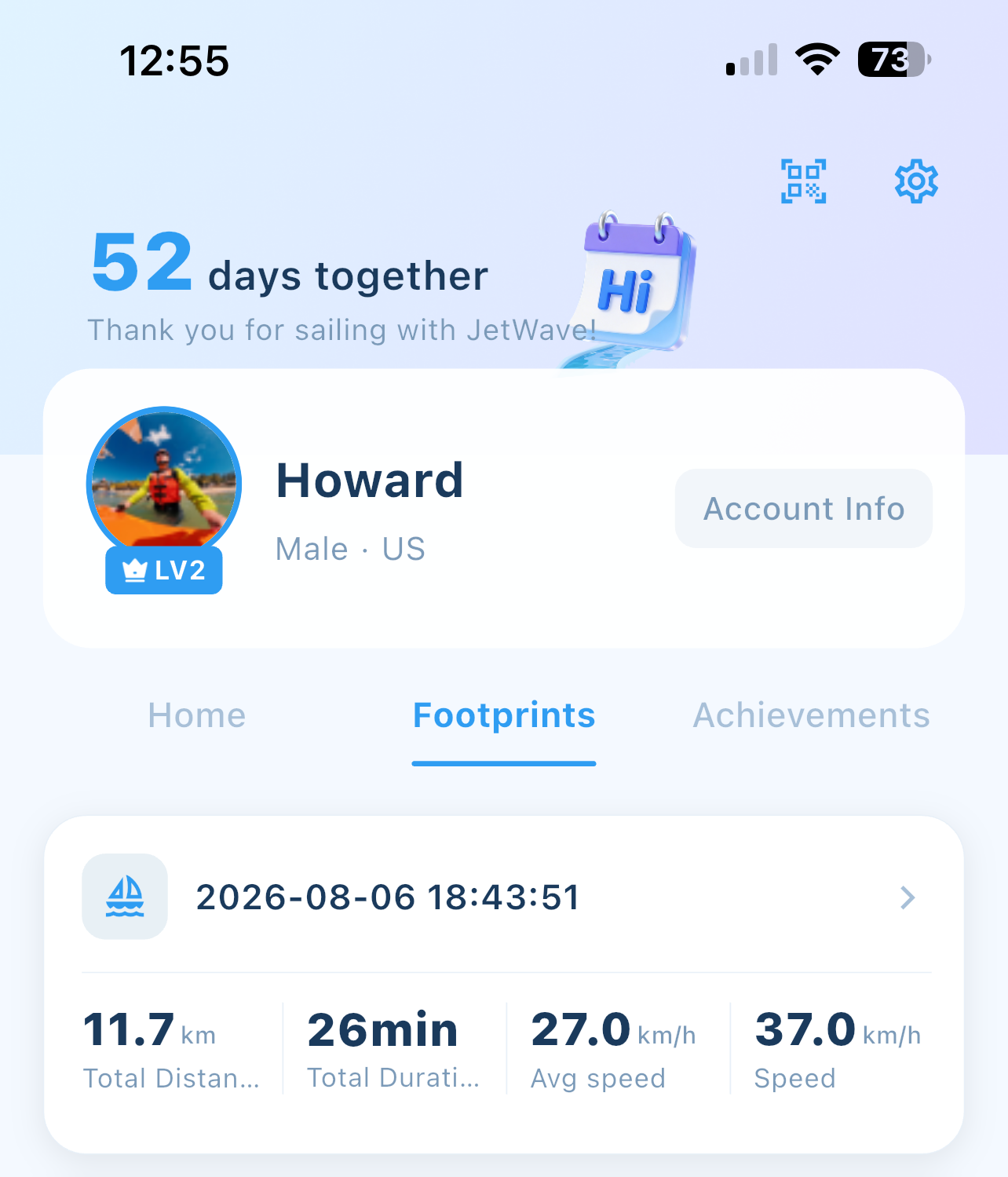
Yesterday I reached 37 km/h (23 mph) on a JetWave Air230 inflatable eFoil—in the middle of a heavy summer storm.
Dark clouds, heavy rain, strong wind, and rapidly changing conditions made the ride dramatic. But something surprised me:
37 km/h on the lake still didn't feel as fast as around 27 km/h (17 mph) in the Pacific Ocean.


That made me think again about something I've learned from eFoiling:
Speed is a number. How fast you feel is a completely different story.
37 km/h Doesn't Always Feel Like 37 km/h
On this ride, I covered 11.73 km (7.3 miles) in 26 minutes 40 seconds, averaging 27 km/h (16.8 mph) and reaching a maximum recorded speed of 37 km/h (23 mph).
Even with the storm around me, there were stretches of lake water that remained relatively predictable.
The ocean is different.
When you're riding in the ocean, the water itself is constantly moving. You have swell, chop, wave surge, and current. The surface rises and falls beneath you, and the water can push you from different directions.
At 27 km/h in the Pacific, I sometimes felt like I was moving faster than I did at 37 km/h on the lake.
Why?
Because GPS speed only tells you how quickly you're moving over the Earth. It doesn't tell you how much the environment is asking your body and foil to do.
In the ocean, you're constantly reading the water, adjusting your balance, controlling foil height, and responding to the next piece of moving water.
Same sport. Different water. Completely different sensation of speed.
Inflatable vs. Carbon: Speed Feels Different Again
The board itself makes another big difference.
The JetWave Air230 is an inflatable eFoil. I enjoy it because it's practical, stable, forgiving, and approachable.
But once I get above roughly 20 mph, I can clearly feel the board's weight and drag.
You're pushing a relatively large inflatable platform through the air, and as the speed increases, that resistance becomes much more noticeable.
That's why I'm especially curious about my next test on a carbon board.
A rigid carbon board should give a more direct connection between the rider and foil, with less flex and a different aerodynamic and hydrodynamic feel.
I'm not only interested in whether the carbon board can produce a bigger number on the screen.
I want to know:
What does 25+ mph actually feel like on carbon compared with 25+ mph on an inflatable?
That's a much more interesting question to me than simply asking which board is faster.
And Then There Are the Maniacs… 😂
And just when 37 km/h starts sounding fast, think about the extreme end of the eFoil world.
The eFoil speed record has reached around 66 km/h — 41 mph / 35.6 knots.
66 km/h on an eFoil. That is maniac territory. 😂
But I say that with a lot of respect.
At those speeds, it's not simply a matter of pushing the throttle harder.
As speed increases, every little movement matters more. Your stance, body position, wind resistance, foil stability, and unnecessary movement all start becoming important.
You actually have to become quieter and steadier.
You're not fighting the whole world with your throttle.
You're trying to find a very precise compromise between the water, the wind, yourself, and the wing beneath you.
And that brings me to what I really love about eFoiling.
There Is No One Right Way to eFoil
Some people love speed.
Some love carving and finding beautiful lines across the water.
Some want to learn jumps and constantly push their skills.
Some love playing with ocean swell.
And some of us are perfectly happy cruising at 10 mph, watching the sunset, talking with friends, and enjoying a relaxed glide across the lake.
That's the real potential of the eFoil community: everyone can find a place for themselves.
You don't need to become the fastest rider.
You don't need to jump.
You don't need to carve aggressively.
And you certainly don't need to chase 66 km/h. 😂
Find the part of eFoiling that makes you happy.
Then, whenever you feel ready, move just a little outside your comfort zone.
Maybe today you're comfortable cruising at 10 mph.
Tomorrow you try a deeper carve.
Another day you work on your low-speed balance.
And someday you might become curious about 20 or 25 mph.
There's always something new to discover.
Slow Doesn't Mean Boring
One thing I especially want beginners to understand is this:
In the eFoil universe, slow doesn't mean boring—and fast doesn't automatically mean skilled.
Low-speed balance is worth practicing even for veteran riders.
When your speed drops, you have less momentum helping you. Small changes in your weight and stance become much more noticeable. Keeping the foil controlled and maintaining a smooth glide at low speed can require real finesse.
Sometimes slowing down exposes weaknesses in your technique that speed can hide.
And high-speed riding has its own lessons.
Going faster doesn't mean fighting the water harder.
You start learning to reduce unnecessary movement. You adjust your body position. You try to reduce wind buffeting and drag. You feel what the foil is doing beneath you and make smaller, more deliberate corrections.
Carving teaches something similar.
You don't force the water to do what you want.
You learn when to apply pressure, when to release it, and when to simply let the foil run.
The better I become at eFoiling, the more I feel that the goal isn't to conquer the water.
It's to work with it.
You're not fighting the world. You're finding a compromise between the water, yourself, and the wing.
That's the eFoil Community I Want to See
I've met amazing eFoil riders and enthusiasts from different places around the world.
Different ages. Different equipment. Different water. Different riding styles. Different reasons for getting on a board.
One person's perfect afternoon might be chasing maximum speed across flat water.
Another person's might be carving.
Someone else wants ocean swell.
And another person might be cruising at 10 mph across a quiet lake at sunset with absolutely nowhere they need to go.
All of them are eFoiling.
And all of them have something they can learn from each other.
That's what makes this community exciting to me.
My 37 km/h ride was fun. I'm proud of that number, and yes, I absolutely want to see what happens when I put the carbon board on the water. 😎
But the number isn't really the point.
The point is that there's always another way to experience the water.
Find your own spot in the eFoil universe.
Cruise slowly. Carve. Explore. Chase speed. Practice balance. Ride the lake. Learn the ocean. Stay inside your comfort zone when that's what you need—and step outside it when you're ready for something new.
There will always be another skill to learn, another feeling to discover, and another friend somewhere in this community who understands why being out there matters.
Why not come glide with us and feel a little more of life on the water? 🌊😎
Want more real eFoil notes from the water?
Get riding tips, board, wing & mast insights, equipment tests, lake scouting reports, and upcoming Triangle ride updates.
Ready to take the next step?
Connect. Ride. Unwind.


Comments